

Hope it's okay to ask here but I have a 161 v3 but only one cart (so can't make a vortex) but I still want to use it on my AES, I think I read an old post about needing a voltage regulator mod, can anyone point me to info on that? Thanks
You are using an out of date browser. It may not display this or other websites correctly.
You should upgrade or use an alternative browser.
You should upgrade or use an alternative browser.
Reverse engineering 161 in 1 cartridge to change Rom games
- Thread starter goguelnikov
- Start date
scrimmybingus
Beginner
Bit by bit I've been slowly working through trying to assemble a VTXCart and it's been going as smooth as it can so far. However, I just want to make sure that I have the best firmware for the STM32H750 flashing step. Is the firmware from ikari_01 still the best firmware to use for this step? Also, I wanted to know about some of the power regulator/capacitor changes that @leonk has made to his VTXCarts, and if they apply specifically to the V2 carts or can work with the usual V3. I also wanted to ask if @leonk is willing to share a dump of his custom UniBIOS that he supplies with his carts. I'd like to thank everyone involved in this project for the countless hours of research and development to make this possible. It's been a blast trying to put one together.

leonk
Professional
If you're programming a V3, Ikari is the best you can get.
Custom Unibios isn't made by me. You can find it here: https://github.com/zardam/ub_vortex_multicart
Custom Unibios isn't made by me. You can find it here: https://github.com/zardam/ub_vortex_multicart
lithy
Enthusiast
I'll see if I need to make a separate WIP thread once I'm a little further along and start jabbering too much, but I actually started into creating a PICKnMIX for Leon's cart list.
After a lot of this...

I finally have my head around how everything is meant to work and I think I'm capable of making the necessary changes and I believe I know how to do it, I'm sure I'll run into some obstacles though.
Just as a start, here is the proposed splash screen. I could have changed the v4.0 line but that was relatively easy since it is in the code as plain text, the line I did change was far more obscured and honestly I still don't know what it's doing or why, but I wasn't going to be happy until I figured out how to make changes to everything on the splash screen and that was the place I thought looked the cleanest. It replaces text saying "--- FREE VERSION ---"

I have an eprom programmer in the mail and plan to do some testing soon. Huge thanks to @kuze for his existing build files, they were invaluable to figuring everything out.
After a lot of this...
I finally have my head around how everything is meant to work and I think I'm capable of making the necessary changes and I believe I know how to do it, I'm sure I'll run into some obstacles though.
Just as a start, here is the proposed splash screen. I could have changed the v4.0 line but that was relatively easy since it is in the code as plain text, the line I did change was far more obscured and honestly I still don't know what it's doing or why, but I wasn't going to be happy until I figured out how to make changes to everything on the splash screen and that was the place I thought looked the cleanest. It replaces text saying "--- FREE VERSION ---"
I have an eprom programmer in the mail and plan to do some testing soon. Huge thanks to @kuze for his existing build files, they were invaluable to figuring everything out.

XtraSmiley
Legendary
I would recommend changing it to v4.1 because of your changes and also the change that allows the controller reset (vice power reset) that was added for this cart.

Creating an increased version number of someone else software is bad form.I would recommend changing it to v4.1 because of your changes and also the change that allows the controller reset (vice power reset) that was added for this cart.
XtraSmiley
Legendary
But making major changes to closed software is OK? I think at this point it should at least be named something different as it's not UNIBIOS 4.0 anymore.Creating an increased version number of someone else software is bad form.
leonk
Professional
You should probably start a new thread about modifying the UNIBIOS code. I'd be interested to see your progress in doing this.
lithy already changed the name by having it be the VTX PICKnMIX edition.I think at this point it should at least be named something different as it's not UNIBIOS 4.0 anymore.
XtraSmiley
Legendary
The line you changed is where he use to provide the serial number of your PCB which can be displayed upon boot and it also proved someone paid for the UNIBIOS (back when he charged for it). The generic FREE VERSION was always the one version behind he would provide for free.the line I did change was far more obscured and honestly I still don't know what it's doing or why, but I wasn't going to be happy until I figured out how to make changes to everything on the splash screen and that was the place I thought looked the cleanest. It replaces text saying "--- FREE VERSION ---"
I think it's a good spot to change, but I think it would be better to change the 4.0 section, but that's just my opinion, it sounds like @ack disagrees!
Pinballjim
Beginner
If you're programming a V3, Ikari is the best you can get.
Custom Unibios isn't made by me. You can find it here: https://github.com/zardam/ub_vortex_multicart
I’ve got a V3 AES cart that rewrite made for me forever ago. Will that work with the soft reset bios? Back then I didn’t have a desoldering station so I piggy backed a Unibios chip onto the old one. Otherwise I’d just burn it and test. If it’ll add soft reset I’ll revisit the motherboard and socket a new rom.
Yes, soft reset bios works with the rewrite card.I’ve got a V3 AES cart that rewrite made for me forever ago. Will that work with the soft reset bios? Back then I didn’t have a desoldering station so I piggy backed a Unibios chip onto the old one. Otherwise I’d just burn it and test. If it’ll add soft reset I’ll revisit the motherboard and socket a new rom.
Pinballjim
Beginner
lol I took one look at those tiny traces on the motherboard and all the solder I globbed on that thing to do the piggy back mod and noped the heck out. Maybe in the next life.
What can be used as a replacement for the MSP55LV100S? I got 2 clean boards from a V3 cartridge — I’ve already bought and installed all the other components , but not the MSP55LV100S. Its also available on Aliexpress, but the sellers aren’t sending it to me.
You can find MSP55LV100S in some GBA carts (bootlegs) and older MVS multicarts such as 120 in 1, 150 in 1, etc.What can be used as a replacement for the MSP55LV100S? I got 2 clean boards from a V3 cartridge — I’ve already bought and installed all the other components , but not the MSP55LV100S. Its also available on Aliexpress, but the sellers aren’t sending it to me.
Maybe you can buy a 150 in 1 locally and cannibalize the chips.
Yes, they’re also found in 23‑in‑1 cartridges for the Sega Mega Drive, but not in all of them. To find 3 chips, you’ll have to go through a bunch of cartridges in the hope that you come across one with the right ones. Neo Geo cartridges for a donor are now worth almost $100.
To check, I transferred the MSP55LV100S chips from another working PROG board. The sound test in 240p Suite shows that FM plays normally, but PCM is very noisy and overloaded. To check, I transferred C4 and C5 from the working board, but that didn’t help. C4 is 240 pF, C5 is 45 pF. I checked the output voltage of the AMS117 — it’s 3.3 V. What else could be wrong?

Hello everyone. I have been following this forum, and this thread in particular, for about five years as an anonymous user.
I decided to register so that I could post my questions and share my progress once I actually begin assembling my Vortex cartridge.
I have been keeping up with the updates in this thread from the very beginning, staying informed about the project's evolution, known issues, tips, and solutions suggested by other users.
I would like to thank everyone who has contributed to this thread by sharing their knowledge and information.
I believe I have a solid grasp of the practical (electronic) side of assembling the cartridge.
As for CPLD programming, file extraction, programming memory chips, and verifying data integrity, I don’t have as much experience, but I am eager to learn through hands-on practice.
I already have some of the components needed for the assembly, though I am still missing a few essential items, such as:
A CPLD programmer, a memory programmer, adapter boards, daughterboards, and various connectors (male and female).
I plan to acquire the remaining equipment soon and begin my journey in assembling a Vortex cartridge.
I intend to put together a custom selection of games, different from those found on existing cartridges, tailored for my own personal use.
I already own an 161-in-1 MVS V2 cartridge, and I will be acquiring another one to use for this Vortex cartridge build.
In any case, at the beginning of August, I came across a listing on AliExpress for a Vortex MVS 153-in-1 cartridge.
The current link for the cartridge is: https://pt.aliexpress.com/item/1005012768209308.html
Note: The PCB images in the listing are not the PCBs we received.
I ended up purchasing one unit.
I suspected it might be a ruse by the AliExpress sellers to gauge interest in the product, and that the order would eventually be canceled.
Whenever the shipping deadline set by AliExpress was about to expire, I would contact the seller to ask if the cartridge was going to be shipped.
I was consistently told that assembling the cartridge and flashing the games onto the memory chips was a time-consuming process, and they would ask me to extend the shipping deadline on the AliExpress platform.
Just as I had decided to cancel the order, lo and behold, the cartridge was shipped.
This was 91 days after I had placed the order. Yes, 91 days later.
I’m emphasizing the duration to make it clear just how long it took.
I received the package containing the cartridge exactly two days ago, and after running some tests, here are my conclusions so far:
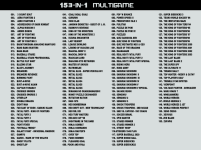
1 - The game list is different from any other Vortex cartridge I have seen to date, both on this forum and in my online research. The listing states that the cartridge PCB is version V7;
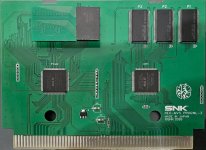
2 - The PROG and CHA PCBs are completely different from any versions of 161-in-1 cartridges I have encountered on this forum or through online research;
3 - Virtually all the fixes and improvements proposed, implemented, and documented on GitHub by the individuals involved, as well as by users in this thread, have been applied to this cartridge;
The specific improvements I’ve identified in this cartridge are as follows:
3.1 - The addition of an extra chip for the C Memory (C3) - Credited to @ack;
3.2 - Dual daughterboard for adding an extra chip for C Memory (C2 and C3) – Credited to @ack;
3.3 - Addition of female connectors to the PCBs to facilitate the connection of daughterboards – Credited to @ack;
3.4 - MVS menu – Credited to @ArcadeTV;
3.5 - Voltage regulators AMS1117-33 on the PROG and CHA boards – Credited to @Vortex and @leonk;
3.6 - Solder pads to simplify connecting the OE1 and OE2 points, enabling C3 – I don’t recall which user suggested this improvement; and
3.7 - 220-ohm resistors connecting pins B28, B29, and B30 to the 5V supply at pins B25, B26, and B27 – Credited to @leonk.
Improvements not implemented:
3.8 - 47pF capacitors between the SDPMPX and SDRMPX control signals – Credited to GadgetUK and @Vortex; and
3.9 - Replacement of the 47pF ceramic capacitors at C5 and C6 (SDPMPX and SDRMPX) with 100pF ceramic capacitors – Credited to @davidmorom.
PS: My apologies if I have attributed an improvement to the wrong person or failed to mention someone.
4 - After brief testing, I confirmed that all the games work.
However, not everything is perfect; here are some issues I identified with this cartridge:
1 - The game list does not include every official title;
2 - The game list does not feature the Turbo version of Metal Slug 2, as is well known, the original version suffers from extreme slowdown when many sprites are on screen;
3 - The version of Garou included on this cartridge is not the prototype version fixed with the patch provided by user @davidmorom or another, it exhibits an error when the character Kim Jae Hoon performs his T.O.P. move;
4 - The version of The King of Fighters 2000 included on this cartridge is not the corrected version provided by user @darknezz19, it displays various graphical glitches in menu text, the striker selection screen, and during actual gameplay;
5 - The version of SVC Chaos on this cartridge is the Hack Remix Ultra edition - which, if I am not mistaken, is currently the only version that can be loaded onto the Vortex cartridge;
6 - Metal Slug 5 exhibits several graphical glitches during the boss fight in Mission 2, to the point where nothing is displayed on the screen at all; and
7 - The cartridge occasionally suffers from audio issues, including incorrect or distorted notes, pitch shifts (notes playing too high or too low), and missing or incomplete sound effects, a problem observed across multiple games.
I believe this is due to the absence of 47pF ceramic capacitors, which are required to eliminate parasitic capacitance on the SDPMPX and SDRMPX signals, as noted by GadgetUK and the @Vortex.
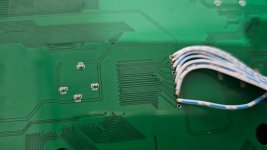
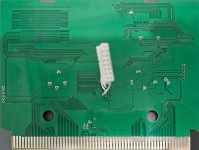
The PROG PCB already includes pads where these capacitors can be installed; they are labeled C5 and C6 on the back of the PROG PCB.
The Irritating Maze game on this cartridge is not the version with the patch provided by user @davidmorom, which allows for controlling the rod using the analog stick and the B, C, and D buttons.
However, the Nightmare in the Dark game on this cartridge is the version with the jump sound corrected, following guidance from user @Niko.
Regarding the games included on this cartridge, when compared to the menu of other existing Vortex cartridges (such as those created by Leon Kiriliuk), the following games, hacks, and homebrew titles are missing:
1 - 240p Test Suite - Homebrew;
2 - Chibi Maruko-chan: Maruko Deluxe Quiz;
3 - Idol Mahjong Final Romance 2 - Neo Geo CD conversion;
4 - Metal Slug 2 Turbo - Hack;
5 - Samurai Shodown 5 Perfect;
6 - The Eye of Typhoon - 3DO game; and
7 - Zintrick - Neo Geo CD conversion.
I will post the manual for this Vortex cartridge, provided by the seller, along with photos of the PROG and CHA PCBs, for documentation purposes and for your own evaluation/analysis.
I hope this information proves useful.
EDIT: I installed 47pF capacitors on the SDPMPX and SDRMPX signal lines (at positions C5 and C6) and reflowed the solder joints for the AMS1117-33 voltage regulators on both the PROG and CHA boards.
The audio issues and the graphical glitches in Metal Slug 5 have been resolved.
Attachments
-
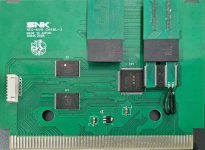 Front CHA.jpg199.2 KB · Views: 9
-
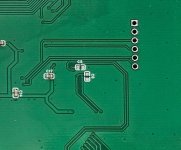 Back PROG 5.jpg84.2 KB · Views: 8
-
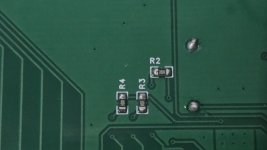 Back PROG 4.jpg132.7 KB · Views: 8
-
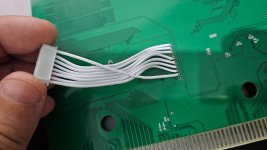 Back PROG 3.jpg124.3 KB · Views: 8
-
 Back PROG 2.jpg94.9 KB · Views: 8
-
 Back PROG 1.jpg223.1 KB · Views: 8
-
 Front PROG.jpg247.3 KB · Views: 9
-
153 in 1.pdf39.5 KB · Views: 3
-
 MVS 153 IN 1 game list.png480.6 KB · Views: 10
-
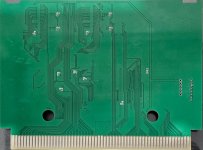 Back CHA.jpg197.1 KB · Views: 9
Last edited:
I had the same problem and managed to resolve it by adding a 47pF ceramic capacitor between each of the two control signals, SDPMPX and SDRMPX, and GND on the PROG printed circuit board (PCB).To check, I transferred the MSP55LV100S chips from another working PROG board. The sound test in 240p Suite shows that FM plays normally, but PCM is very noisy and overloaded. To check, I transferred C4 and C5 from the working board, but that didn’t help. C4 is 240 pF, C5 is 45 pF. I checked the output voltage of the AMS117 — it’s 3.3 V. What else could be wrong?
Keep in mind that the cartridge pins where these signals are located differ between MVS and AES systems.
Take a look at the links:https://wiki.neogeodev.org/index.php/AES_cartridge_pinout
https://wiki.neogeodev.org/index.php/MVS_cartridge_pinout
Check the signal traces from the cartridge pin to the PCM2 to see if the capacitors are already present.
In some cases, the capacitors are missing; in others, they are present but have a capacitance value other than 47pF; and in some instances, a capacitor is missing from only one of the two signals.