

rotary switch (not soldered on yet) or the 10-pin header can go to my LCD selector or a remote mounted rotary or dip selectorHow do you switch?
rotary switch (not soldered on yet) or the 10-pin header can go to my LCD selector or a remote mounted rotary or dip selectorHow do you switch?
yesDo you anticipate this multi being limited to/compatible with specific rom boards?
So for now this will only work with the 171-7919A donor cart, you'd need to remove all of the old ROMs (or at least lift their enable pins) then install the 10 fly wires, program the ROM modules and the GAL. Theoretically it should be able to support games that utilize the "leftover" gap between IC22 and ROM1 which normally cart conversion on this cart couldn't do. It should also be able to fit games that are larger than that cart originally supported. 4x 1Gbit modules = 256MB and it should be able to support any combination of 1 to 16 games that will fit in that space.
I'm using 74LVC4245, same ones used by DS on the Namco multis and by aje_fr on his SH2 multi.Are you using fixed direction translators or unidirectional ?

data does not get corrupted. The Modules themselves I think are fine, I'm using DS's original design unmodified and can write to them and read from them using a PROMAN and NOR flash program with 100% success.Do you mean the data on the flashes get corrupted? How do you handle the WP and RST signals ?

those are disconnected on my PCB since I'm not using it to write, but the module itself pulls them up to 3V3.How do you handle the WP and RST signals ?
I didn't catch that, that's an easy fix but I don't think it explains the behaviour I'm seeing (I'm also not seeing pull ups on some of the other multi's that are using this chipsRegarding LVC245s the datasheet recommends using a pull-up resistor to Vcc if used in forced A to B translation.
 )
)
Interesting idea, I don't have a good setup to run that test at the moment unfortunately.Can you throw a scope on two of the data lines using CE as a trigger to see if you have ringing?


I have 90% of the research done on this one because I worked out conversions for nearly every joystick game on the platform. the problem is that it uses a BOAT LOAD of Graphics ROMs, hence why the existing multi is just a 4 in 1There’s yet this other one now with another 4 games including Twin Eagle 2 but no Storm Blade.
looking through the datasheet I'm not seeing a pull-up resistor recommendation:Regarding LVC245s the datasheet recommends using a pull-up resistor to Vcc if used in forced A to B translation.

Storm Blade and Drift out 94 use an extra Math CO-Processor on the ROM board that would need to be implemented, probably why it's not been added to the 4 in 1.


WP is active low, therefore must be tied to ground for write protection.those are disconnected on my PCB since I'm not using it to write, but the module itself pulls them up to 3V3.
That's the datasheet from TI I was refering to.looking through the datasheet I'm not seeing a pull-up resistor recommendation:
https://www.ti.com/lit/ds/symlink/sn74lvc4245a.pdf
is this maybe recommended on a different brand/model LVC245
I did know about that. What I don't know is if the ST010 is pin-compatible with the NEC uPD96050 or if there are differences that needs to be taken into account.The Math Co-Processor is the Seta ST010, which Seta also used for the Super Famicom game Exhaust Heat 2 / F1 ROC II: Race of Champions. Supposedly, decapping revealed that it's a rebranded NEC uPD96050 so parts could possibly be sourced.
I think we're talking slightly different devices.WP is active low, therefore must be tied to ground for write protection.
That's the datasheet from TI I was refering to.
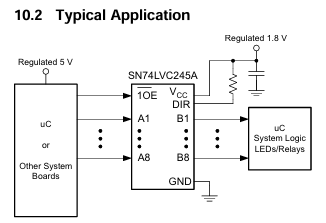
There's also this regarding OE:

Not sure how critical that is, just throwing ideas.
I'm using 74LVC16T245 myself and I learned the control signals must follow the levels on the A side.



