CPS1 Real Arcade vs Fightcade vs MiSTer - 3 Way Showdown...

@MickyMac Thank you for sharing! Since I discovered that lag exists 25 years ago I got very sensitive to it. I too plan to make some measurements in the future when I finally get my PS5 controller LED modded running @1000Hz polling on the Mister via CRT of course.

And yes CPS has lag, 2 frames to be precise (apparently). It's due to sprite buffering to achieve "more sprites on screen" than "usually". Takumi games though, 3 frames. Backgrounds are not buffered and thrown "directly" on the screen. You can notice the lag between BGs and sprites in the Final Fight train stage. Look at the handle things at the top of the screen when the train shakes up/down in slo/mo. BG and these sprites are not in sync. Same goes for the staff roll where text and pictures are not thrown in sync on the screen.

@djsheep I just recently stumbled upon his channel and his lag measurements seem legit. That's the only field I'm interested in his channel and the whole Groovy Mister affair.

Would you mind to elaborate a little bit?

Edit: In your VAPS Profile there is a Metal Black "single layer". I always thought it exists only as two board setup.
 
Last edited:
Here is updated CPS1 test:

My boardset runs about 1 second slower than yours for 1 round. Yours is 54.154 seconds for the countdown timer to go from 99 to 00, starting from the frame that 'FIGHT!' disappears off the screen to the frame when 'TIME OVER' appears on the screen. Mine is 55.199 seconds.

I video recorded it the same way you did: 2-player Ryu vs. Ken with Ryu constantly jumping up and down, except it happened to be on the Blanka stage rather than the Ryu stage.

I'm using a 10 MHz A-board from a World Warrior boardset, but I replaced the 10 MHz crystal with a 12 MHz one.

[...]

Well this is weird. I stopped typing this post to do another test, and this time it happened to be on the Ryu stage like in your video. The time was 54.232, which is probably within the margin of error for being the same time as yours, especially since I recorded at 30 FPS and you recorded at 59.94 FPS.

I wonder why the stage makes a difference?

1.png
2.png
 
My board is original Hyper Fighting imported from Japan with original Hyper fighting hardware.

I think it's best to record higher frame rate since 30 I can see "skipping" frames.

The 30 frames per second of my video consists of 60 fields per second (interlaced), and SFII runs at 60 Hz, so every frame was captured as a field. Your video is 59.94 frames per second (progressive), so it's a slight mismatch to SFII's frame rate, which means your recording drops a frame every ~16.7 seconds.

Some stages are known to be faster than other.

That's strange. Does anyone know why?
 
Last edited:
Fields. It’s a new measurement the MiSTer community will use to prove cycle accuracy…

There's nothing new about fields. Interlaced video is inherently made up of fields (the original NTSC standard from the 1940s was 60 fields per second; that was changed to 59.94 fields per second in the 1950s when color was added to the signal). With regard to interlaced video, each frame consists of 2 interlaced fields, so 60 fields per second = 30 frames per second.

And what does MiSTer have to do with anything? I've never used MiSTer before. My SFII: HF game is running on a Capcom CPS-1 boardset (JEDEC EPROM type) connected to a Happ Vision Pro 15.7 kHz CRT arcade monitor in a Dynamo HS-1 cabinet.
 
There's nothing new about fields. Interlaced video is inherently made up of fields (the original NTSC standard from the 1940s was 60 fields per second; that was changed to 59.94 fields per second in the 1950s when color was added to the signal). With regard to interlaced video, each frame consists of 2 interlaced fields, so 60 fields per second = 30 frames per second.

And what does MiSTer have to do with anything? I've never used MiSTer before. My SFII: HF game is running on a Capcom CPS-1 boardset (JEDEC EPROM type) connected to a Happ Vision Pro 15.7 kHz CRT arcade monitor in a Dynamo HS-1 cabinet.
Ignore the haters, I find all of this interesting, despite not having the in-depth knowledge of it. Keep the tests running, I'm always curious about this stuff. My uneducated guess is that all PCBs have slight variances between them, although these differences seem rather large.

As for the stages, could it be slowdown related due to background animations?
 
How does this affect the actual purpose of why these games exist? To actually enjoy playing them as a f*cking game?

TL;dr…just play the damn games as you like to on whatever you like (or are best able) to.

This subforum is about CPS-1 hardware, not about gameplay enjoyment. And this thread is about the speed at which the hardware runs SFII: HF vs. an emulator and a MiSTer FPGA core. I find the OP's experiment interesting, and it fits in this subforum.

Spare us the science; talking about fields & framerates is now heading into OCD overdrive.

Are you a moderator?
 
The 30 frames per second of my video consists of 60 fields per second (interlaced), and SFII runs at 60 Hz, so every frame was captured as a field.

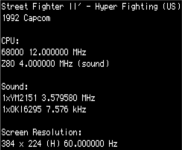
FWIW, CPS1 doesn’t actually run at 60 Hz - it refreshes at 59.637405 Hz. So both progressive and interlaced capture are going to end up dropping an occasional frame.
 
Last edited:
The 30 frames per second of my video consists of 60 fields per second (interlaced), and SFII runs at 60 Hz, so every frame was captured as a field. Your video is 59.94 frames per second (progressive), so it's a slight mismatch to SFII's frame rate, which means your recording drops a frame every ~16.7 seconds.

Are you certain that you captured at a true 60i interlaced? The label in the capture software may say “30 FPS Interlaced” but if your equipment is setup for NTSC standards then it’s really capturing at 59.94i and not a true 60i.
 
FWIW, CPS1 doesn’t actually run at 60 Hz - it refreshes at 59.637405 Hz. So both progressive and interlaced capture are going to end up dropping an occasional frame.

I was going by what the old version of MAME I have says:

1.png

But after reading your post I checked a much newer version of MAME and it indeed says 59.637405 Hz.

Are you certain that you captured at a true 60i interlaced? The label in the capture software may say “30 FPS Interlaced” but if your equipment is setup for NTSC standards then it’s really capturing at 59.94i and not a true 60i.

I didn't use capture software, I used an old digital camera pointed at the monitor. And yes, it is 30 frames per second. Not only does MediaInfo and other video software report it as 30.000 frames per second, but if I open it in something like VirtualDub, frame 30 is at exactly the 1-second mark (0:00:01.000), frame 60 is exactly at the 2-second mark (0:00:02.000), frame 600 is at exactly the 20-second mark (0:00:20.000), and so on. It doesn't matter though, since, as you pointed out, SFII doesn't actually run at 60 Hz, so both recordings are a slight frame-rate mismatch anyway.
 
My board is original Hyper Fighting imported from Japan with original Hyper fighting hardware.

Have you confirmed the board has a 12mhz crystal? It was not unheard of even in Japan for operators to convert WW/CE boards (10mhz) to Hyper Fighting (12mhz).

It may be helpful to validate this just in case, but once Maxim re-ran the test on the same stage, seems like both of your boards match so you most likely have 12mhz (IMO).

I just recently stumbled upon his channel and his lag measurements seem legit. That's the only field I'm interested in his channel and the whole Groovy Mister affair.

Would you mind to elaborate a little bit?

RetroRGB's lag testing methodology is solid. But I don't think it really matters in this case since I don't even know that he tested GroovyMiSTer's input lag, it seems like all he did was link to Neon Dagger's video (and Neon Dagger did the testing).

That's strange. Does anyone know why?

I'd love to know this as well. This is also a known thing in ST and has also been brought up in Harineto's thread about that game. Maybe it's like how in modern games like Marvel 3 you can get frame drops due to too much stuff happening in the background and since the game timer is tied to frames, it runs fast due to frame drops?

How does this affect the actual purpose of why these games exist? To actually enjoy playing them as a f*cking game?
[...]
Spare us the science; talking about fields & framerates is now heading into OCD overdrive.

This thread is about measuring accuracy of the MiSTer core, and Harineto is doing so by counting frames against real hardware. It is not about discussing casual play (for which the MiSTer core is more than good enough). However, the accuracy of the core absolutely matters for use in competitive settings, as well as for long-term preservation.

Put simply, the thread is about "science". So it might not be the thread for you!

There's nothing new about fields. Interlaced video is inherently made up of fields (the original NTSC standard from the 1940s was 60 fields per second; that was changed to 59.94 fields per second in the 1950s when color was added to the signal). With regard to interlaced video, each frame consists of 2 interlaced fields, so 60 fields per second = 30 frames per second.

This is a fair point but does it matter here given that both of Harineto's sources are being recorded at 59.94? Even with the frame drops, the footage should remain synced assuming both of them are 59.94. If you look at the comparison he did for the two real PCBs, they never desync despite the CPS2 also not running at a perfect 60Hz (or even 59.94 - I think it's something like 59.63 like CPS1).

Wouldn't this only make a meaningful difference if it was comparing against a camera pointed at a CRT recording at 30i? Maybe I am misunderstanding something.

And what does MiSTer have to do with anything? I've never used MiSTer before. My SFII: HF game is running on a Capcom CPS-1 boardset (JEDEC EPROM type) connected to a Happ Vision Pro 15.7 kHz CRT arcade monitor in a Dynamo HS-1 cabinet.

Don't feed the trolls.

 
This is a fair point but does it matter here given that both of Harineto's sources are being recorded at 59.94? Even with the frame drops, the footage should remain synced assuming both of them are 59.94. If you look at the comparison he did for the two real PCBs, they never desync despite the CPS2 also not running at a perfect 60Hz (or even 59.94 - I think it's something like 59.63 like CPS1).

Wouldn't this only make a meaningful difference if it was comparing against a camera pointed at a CRT recording at 30i? Maybe I am misunderstanding something.
I only mentioned the difference between his video's frame rate and my video's frame rate as a possible contributor to the 0.078-second difference between his 1-round time and mine (in my second test on the Ryu stage). In his and my videos I used the time stamps at specific frames to determine how long the 1-round timeout took, and when you have a frame-rate mismatch between the camera (or capture software) and the game itself, the frame at which you see "FIGHT!" disappear isn't exactly when it disappeared on the monitor in reality, and likewise for the frame where you first see "TIME OVER" appear in the video captures. So that alone adds a certain margin of error to both his and my videos when trying to compare the two using in-game reference points.
 
An usual methodology for measuring input lag (but it could be relevant here too) is using a phone for recording a high speed video (120 or 240FPS) of the CRT. The resulting video can be ugly to watch, but is useful for counting frames with “high resolution timings”.
If the two boards are outputting the exact same (very very) long animation you sync the two videos at the beginning of the very first frame (when you see for the first time the fist frame of game animation in the high speed video) and the you count the video frames (until see for the first time the last frame of game animation in the high speed video).
The recorded video doesn’t have to be in sync with the game framerate in order to evaluate board de synchronizations and higher framerates lead to better time resolution.
 
Last edited:
Back
Top