You are using an out of date browser. It may not display this or other websites correctly.
You should upgrade or use an alternative browser.
You should upgrade or use an alternative browser.
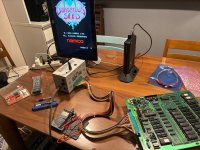
Multi Namco system 1 black screen
- Thread starter raffy92
- Start date


If the short is on the +5V line, you can ignore the audio section for now. Separate the two PCBs and measure between +5V and GND to identify which of the two boards has the short circuit.
Check if there is a faint burning smell. Inspect the decoupling capacitors (ceramic disc ones) and pay special attention to any tantalum capacitors (teardrop-shaped ones), as they are notorious for failing short to ground.
On the solder side, make sure there are no bent pins touching each other. Also, check the component side to ensure there isn't a loose solder splash or blob shorting anything out.
Check if there is a faint burning smell. Inspect the decoupling capacitors (ceramic disc ones) and pay special attention to any tantalum capacitors (teardrop-shaped ones), as they are notorious for failing short to ground.
On the solder side, make sure there are no bent pins touching each other. Also, check the component side to ensure there isn't a loose solder splash or blob shorting anything out.

Listen to Master Tovar. He knows what he's talking about.If the short is on the +5V line, you can ignore the audio section for now. Separate the two PCBs and measure between +5V and GND to identify which of the two boards has the short circuit.
Check if there is a faint burning smell. Inspect the decoupling capacitors (ceramic disc ones) and pay special attention to any tantalum capacitors (teardrop-shaped ones), as they are notorious for failing short to ground.
On the solder side, make sure there are no bent pins touching each other. Also, check the component side to ensure there isn't a loose solder splash or blob shorting anything out.

Thanks, That's exactly what I wanted to hear: a description of what needs to be done.If the short is on the +5V line, you can ignore the audio section for now. Separate the two PCBs and measure between +5V and GND to identify which of the two boards has the short circuit.
Check if there is a faint burning smell. Inspect the decoupling capacitors (ceramic disc ones) and pay special attention to any tantalum capacitors (teardrop-shaped ones), as they are notorious for failing short to ground.
On the solder side, make sure there are no bent pins touching each other. Also, check the component side to ensure there isn't a loose solder splash or blob shorting anything out.
I separated the two boards and checked the resistance between 5V and GND on the JAMMA board. With the multimeter set to continuity mode, I sometimes get a beep for a fraction of a second, but most of the time there is no beep. I get the same result when checking 12V to GND.If the short is on the +5V line, you can ignore the audio section for now. Separate the two PCBs and measure between +5V and GND to identify which of the two boards has the short circuit.
Check if there is a faint burning smell. Inspect the decoupling capacitors (ceramic disc ones) and pay special attention to any tantalum capacitors (teardrop-shaped ones), as they are notorious for failing short to ground.
On the solder side, make sure there are no bent pins touching each other. Also, check the component side to ensure there isn't a loose solder splash or blob shorting anything out.
The resistance between 5V and GND is quite high, around 4 MΩ, although it is not stable. Between 12V and GND, I get around 1.5 kΩ, which gradually decreases to about 0.54 kΩ and then remains stable.
With the CPU board connected to the JAMMA board, I measure around 0.55 kΩ between 5V and GND, and around 0.56 kΩ between 12V and GND.
I also found a partially broken-off component lead underneath the JAMMA board, very close to an adjacent lead. I'm not sure whether it could have been causing a short circuit, but I removed it.
Great news! Your measurements are perfectly healthy and completely rule out a dead short circuit on the board.
The fraction-of-a-second beep is totally normal. It’s just the capacitors on the board charging up from the multimeter's test voltage.
Measuring 0.55 kΩ (550 ohms) on the 5V line with both boards connected is exactly what you want to see. If there were a true short, it would read close to 0 ohms and the beep would be continuous.
That broken component lead you removed was likely the actual culprit! If it got pushed down and bridged two traces or pins, it would definitely cause an intermittent short.
Since the board is safe and shows no shorts, the next step is to carefully plug it back into your setup, verify the 5V level at the JAMMA edge with the power on, and see if the game boots up.
The fraction-of-a-second beep is totally normal. It’s just the capacitors on the board charging up from the multimeter's test voltage.
Measuring 0.55 kΩ (550 ohms) on the 5V line with both boards connected is exactly what you want to see. If there were a true short, it would read close to 0 ohms and the beep would be continuous.
That broken component lead you removed was likely the actual culprit! If it got pushed down and bridged two traces or pins, it would definitely cause an intermittent short.
Since the board is safe and shows no shorts, the next step is to carefully plug it back into your setup, verify the 5V level at the JAMMA edge with the power on, and see if the game boots up.
Thanks for your comment. I am not sure of the broken leg below the board is the culprit but apparently there is no short circuit. I will try again to power it onGreat news! Your measurements are perfectly healthy and completely rule out a dead short circuit on the board.
The fraction-of-a-second beep is totally normal. It’s just the capacitors on the board charging up from the multimeter's test voltage.
Measuring 0.55 kΩ (550 ohms) on the 5V line with both boards connected is exactly what you want to see. If there were a true short, it would read close to 0 ohms and the beep would be continuous.
That broken component lead you removed was likely the actual culprit! If it got pushed down and bridged two traces or pins, it would definitely cause an intermittent short.
Since the board is safe and shows no shorts, the next step is to carefully plug it back into your setup, verify the 5V level at the JAMMA edge with the power on, and see if the game boots up.
The game is working again . Thank you master Tovar, Astro X and DarksoftThanks for your comment. I am not sure of the broken leg below the board is the culprit but apparently there is no short circuit. I will try again to power it on