
Universal JVS I/O, Interest Gathering

bsnike

Beginner
Joined
Jun 23, 2022
Messages
4
Reaction score
10
Location
UK
I've been working on a universal I/O board, designed to stand in for even the weirdest arcade I/O boards (looking at you, Type 2 and Taito USBIO).

Currently it supports:
  • 64 channels of bidirectional I/O
    • Outputs are open-drain, rated for 24V at 1A continuous, with up to 2A on individual channels
    • Inputs are active-low and are 24V tolerant
  • 4 dedicated coin meter outputs
    • Open-drain, rated for 15V at 1A continuous
    • Sensing to detect a removed or bypassed meter
  • 8 analogue inputs
    • Rated for 0-5V
    • Approximately 9 bits of precision, approximately 11 bits with over-sampling
  • JVS in and out, with automatic termination and detection of a powered-off downstream board
  • 4 external serial ports
  • 1 external SPI bus
  • USB Full Speed interface
The board exposes all of these signals (and a few general purpose 3.3V signals) over a pair of headers. Daughterboards are attached on top (think Raspberry Pi HATs) to then adapt these connectors and signals to the specific connectors (eg JST RA) and interfaces (eg RS232 or RS422) for whatever cabinet or game you're working with.

Here's the base board as it stands. Expect it to change.
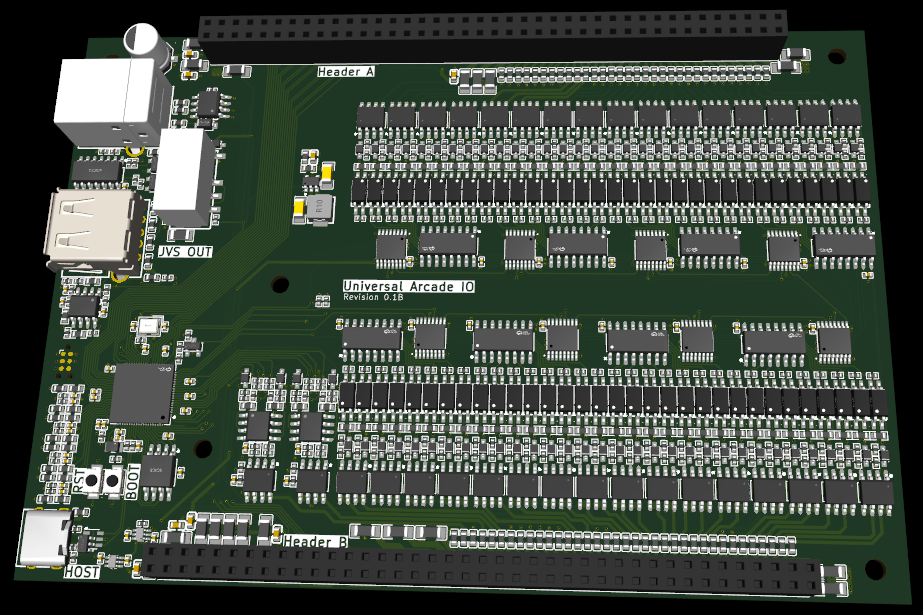
Preview render of rev 0.1B base board

I haven't designed any daughterboards yet, and I'd like to know what people would actually need before I do. In particular:
  • Does this entire idea sound interesting to you?
  • What cabinets, games, or I/O boards would you want to replace or emulate?
  • What connectors or interfaces would you want on a daughterboared?
Pricing isn't settled, but I'm expecting somewhere around $100-150 for a base board plus one daughterboard. Where it lands depends a lot on how many I end up making.
 
For reference regarding the daughterboard idea, here's one I mocked up quickly that provides the interfaces expected of a Type 1.5, 3, or 4 SEGA IO board (though I don't have the CAN interface for Type 4 here because nothing uses that).

Baseboard with SEGA daughterboard attached


Because most of the complex circuitry lives on the mainboard, daughterboards can be really simple in their own design.
 
Interesting. though I'm not clear on what problem you're trying to solve with this?

From a cost perspective original JVS IOs are likely going to be less expensive from this.

From a compatibility perspective the MultiJVS project: https://www.arcade-projects.com/threads/multi-jvs-v1-0.13532/ is already tackling the software problem of certain games demanding specific JVS io boards with it's ability to essentially spoof requirements.

I think the "hat" on the board to adjust the pinout is interesting, but I would highly recommend you consider PCB mounting holes and connectors in the same positions as the original board you're trying to emulate otherwise you run the risk of not being able to bolt it into the cab as a drop in replacement and have the harnesses reach the connector positions.
 
On cost, I think that's absolutely fair for a lot of the more common JVS boards. I'm not expecting someone to buy one of these to replace a readily available original board that costs half as much.

Part of the appeal of this architecture to me is that the cost of producing a replacement for a relatively obscure or expensive I/O board needn't be substantially different from the cost of producing a replacement for a common one. Equally, being able to keep a common baseboard on hand with a few different daughterboards might be quite useful from a maintenance perspective.

MultiJVS is a really cool project, but I'm aiming for something that's rather a bit more universal. Even within the scope of JVS, I'd like this to be a considerably more capable I/O board in its own right, with the aim of retaining all of the hardware functionality of the more complex original boards rather than just achieving protocol compatibility. Beyond JVS, I've already had thoughts about how it could function on a Maple interface, for example.

The flexibility to be able to adapt to any particular board is part of why I've gone for 64 I/O channels, rather than (again, for example) saying "A SEGA Type 4 needs 32 input channels, 20 output channels, 2 coin meters and 8 ADC channels" and designing around those requirements. If we took that architecture and tried to be a drop-in for a Taito board we'd be missing 8 output channels, 4 UARTs, two extra coin meters, etc.

Those "hats" are where a lot of extra application-specific logic ends up sitting. For example, the one pictured is for SEGA boards and adds 8 dedicated high-speed input channels (that still retain the same protection as the other inputs), which are required for things like rotary encoders and printer interfaces. A JAMMA hat would end up having some circuitry on there to handle video, whilst being able to rely on the mainboard for the high-power I/Os.

It's absolutely a little over-specced in places at a surface level, but having studied original boards and some of their more extreme applications I don't think it's actually unwarranted.

Matching mounting holes was something I thought about, but even just within SEGA boards the hole locations are wildly different, and that's not even starting to think about boards from different manufacturers. I don't think it would be unreasonable to use an approach similar to MEGA-JVS here, where the board just gets mounted onto a carrier plate that translates the hole positions. Connector positioning is a very good point though, particularly where the original harnesses don't have much slack; the pictured example board was mocked up in about 20 minutes as a quick demo, and as a test for myself to see if the platform really was as easy to design daughterboards for as I had hoped.

Part of what I'm hoping to establish with this thread is which boards people actually struggle to source, and where a replacement at this price point would make sense. Are there any particular boards you've encountered that you think would be worthwhile targets?
 
I work with a lot games with obscure non-standard interfaces and I've not had difficulty sourcing whatever IO board I needed, and those that I haven't been able to get my hands on are so obscure you wouldn't be able to replicate them here because it'd require having one in hand in order to understand what to replicate. On a whole those are probably not even worth attempting to replicate with something like this because there are maybe 3 people on the planet that would care about it.

For me this is an interesting concept but I don't know that I personally find any utility in it for anything I need. I think that's why I asked the original question of what problem you're trying to solve here.
 
Back
Top